Healthcare Cleaning Is a Specialist Skill. The Training Gap Is Proving It.
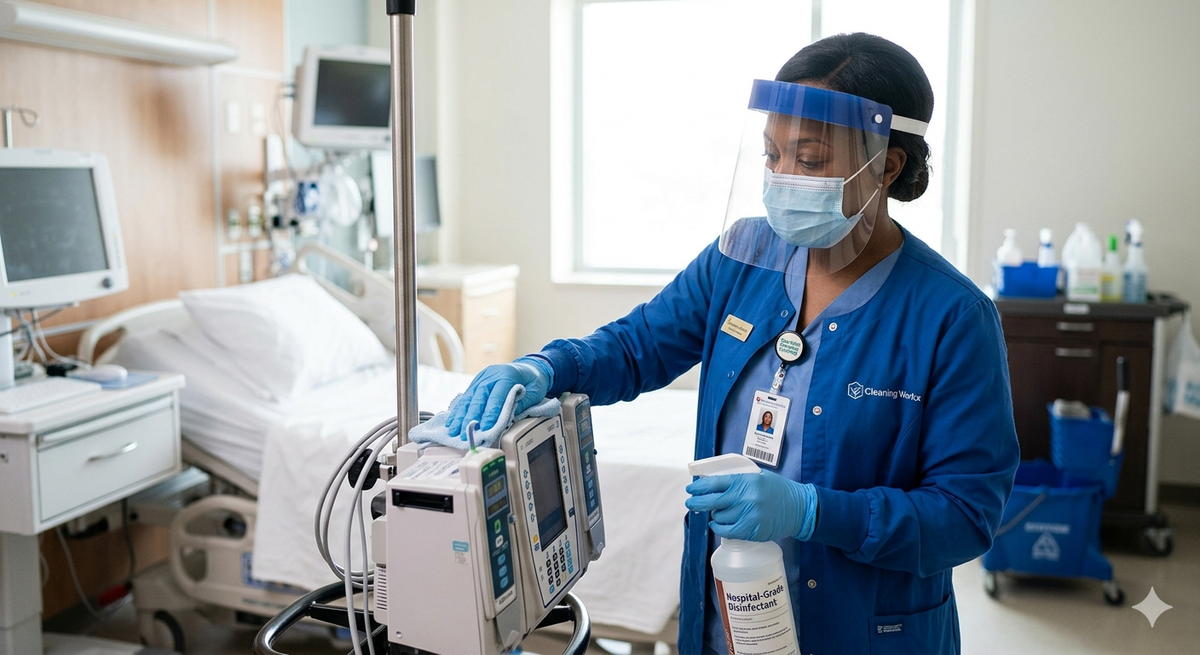

There is a number that should stop every Head of Environmental Services mid-sentence. Fifty-four percent of hospitals surveyed identify improper cleaning and disinfection of medical equipment as a top compliance issue — placing it firmly among the most common failures identified in Joint Commission reviews. Not a niche problem. Not an edge case. The number-two compliance failure in hospitals, according to data published by Barrins & Associates, an organisation that specialises in Joint Commission and CMS preparedness.
Read that again. In more than half of hospitals surveyed, the people responsible for cleaning the equipment that keeps patients alive are not doing it correctly — at least not consistently enough to pass scrutiny.
That is not an indictment of EVS workers. It is an indictment of how we train them.
The commercial cleaning playbook does not transfer
Here is the assumption most training programmes make implicitly: that cleaning is cleaning. You learn the product, you learn the motion, you learn the schedule. Done.
In a commercial office, that assumption is roughly defensible. In a hospital, it is dangerous.
Healthcare cleaning operates inside a different system entirely. Surfaces carry pathogens that survive for hours or days. Equipment — endoscopes, infusion pumps, surgical instruments — has manufacturer-specific decontamination requirements that, if ignored, can render disinfection meaningless. Biohazard handling requires knowledge of CDC and OSHA guidelines that most general cleaning curricula do not cover. The sequence in which rooms are cleaned, the dwell time of a disinfectant, the difference between cleaning and disinfection and sterilisation — these are not refinements of general practice. They are a separate discipline.
ISSA, the worldwide cleaning industry association, makes this explicit in its case for medical cleaning certification: healthcare environments require specialised cleaner training that general commercial certification simply does not address. The physical act of wiping a surface may look identical. The knowledge required to do it safely, in a hospital room, is not.
Treating them as equivalent is the root cause of the compliance gap we are measuring.
Language is not a soft issue. It is a safety issue.
Here is the second fault line — and it is one the industry talks around rather than through.
EVS teams in most healthcare systems are multilingual by nature. They represent some of the most linguistically diverse workforces in any sector. And the dominant training response to that reality has been, effectively, to ignore it. Protocols are printed in English. Compliance posters are in English. Digital training platforms default to English. Trainers deliver in English, or in one other language if the team is lucky.
When a cleaner misunderstands a disinfection protocol because it was delivered in a language they do not fully command, that is not a training failure on their part. That is a system design failure. The risk was built in before they set foot in the room.
This matters doubly in healthcare, where the margin for misunderstanding is measured not in damaged furniture but in healthcare-associated infections. HAIs affect millions of patients annually and represent one of the most persistent and costly patient-safety challenges in modern hospitals. Environmental cleaning is a documented variable in HAI transmission rates. The connection between language-accessible training and patient outcomes is not theoretical.
The professional standard already exists
What makes the current situation genuinely frustrating is that the framework for doing this properly is not missing. It exists.
The Association for the Health Care Environment (AHE) has developed the Certified Nurse Aide and Cleaning Certification (CNACC) programme, and its Train-the-Trainer model provides a structured, evidence-based foundation for EVS training at scale. Australia's healthcare regulatory landscape similarly mandates specific cleaning standards and competency requirements that go well beyond general commercial protocols. The professional infrastructure is there. The question — the real operational question — is how you deliver it.
How do you train a team of 200 cleaners spread across three hospital sites, speaking eight languages, with a turnover rate that means the cohort has partially changed before the previous cohort has finished onboarding? How do you ensure that the person who joins on a Tuesday at 06:00 before the morning shift receives the same quality of instruction as the person who joined six months ago during a dedicated training week?
The honest answer, for most organisations, is: you don't. You depend on a senior member of staff passing something down, on a laminated card, on someone's memory of what they were told. That is how 54% of hospitals end up with a compliance failure in this specific area.
Consistent, verifiable training is not an HR project — it is an audit asset
There is a practical argument here that goes beyond patient safety, important as that is.
EVS leaders operating in accredited healthcare environments are asked, repeatedly and formally, to demonstrate that their teams are trained. Not that training happened once. That it happened correctly, that it covered the right material, and that there is a record of it. Joint Commission surveys, CMS reviews, infection-control audits — all of them require evidence, not assurances.
An EVS director who can produce verifiable, role-specific completion records for every member of their team — in a format that maps to recognised standards — is in a fundamentally different position during an accreditation review than one who cannot. That is not bureaucratic box-ticking. It is the difference between passing and not.
Scalable training infrastructure — the kind that delivers consistent content, generates documented certification, and does not collapse when the one person who holds all the institutional knowledge goes on leave — is, in this context, an operational necessity. It is also, frankly, a competitive one. Cleaning organisations tendering for healthcare contracts increasingly face procurement requirements that reference training standards directly. The ability to demonstrate structured, certified EVS training is moving from differentiator to baseline expectation.
What this actually looks like
None of this requires discarding what good EVS trainers already know. The expertise in those teams is real and hard-won. The goal is to make it consistent and transferable — to encode it in a format that works for a team member who speaks Portuguese as well as one who speaks English, for someone onboarding in week one as well as someone refreshing their knowledge in year three.
That means training built specifically for healthcare environments: infection-control fundamentals, equipment-specific procedures, biohazard protocols. It means delivery in multiple languages, not as a translation add-on but as a structural requirement. And it means outcomes that are documented and defensible — not because compliance culture demands paperwork, but because the people being trained deserve a system that takes their professional development seriously.
Healthcare cleaning is a specialist skill. The evidence is clear on what happens when training does not reflect that. The question now is whether the organisations responsible for that training are willing to build something that actually matches the work.